What Can You Afford?
How much do you make each month? How much do you spend each month? That may be a good place to start.
If you look at your paychecks, it should be pretty easy to figure out how much you make per month. What really matters is how much you lose a month — because if you’re moving out, you’ll need a fair bit of spare money on the first of every month.
You’ll want to track your expenses for a few months to figure out how much you regularly spend. This can be easily split up to categories like groceries, entertainment, transportation and more, then put into an spreadsheet. Some banking services will even do it for you.

REMEMBER TO CONSIDER THESE THINGS:
- If your job has an off-season or you work part-time, consider how that will affect your income, especially if tips are involved.
- Do you have student debt? If you do, you’re going to have to pay your loan each month as well.
- Same thing goes with cell phone bills, any type of insurance, and all those pesky unexpected expenses adulthood tends to be wrought with. Say you take an arrow to the knee and need to go to the hospital — you’ll need to be able to pay that too.
Hence why your budget should never be too tight. If it is, you may need to step back and consider some other things before diving into renting.
Similarly, you may want to start leaving a little extra room to save up for all those upfront costs, like the security deposit or application fee. Not to mention, when you start renting, there are a whole bunch of other costs you can look forward to: water bills, utilities, renters insurance and maybe even a garbage or pet fee. A water bill can be around $50 a month while gas and electricity ranges from $50 to $200 a month, depending on the season.
This is a lot to remember and it can make you freak out a little bit. However, there are some other guides to help you decide if you can afford to make that move.
The U.S. Department of Housing and Urban Development defines affordable housing as paying no more than 30% of your take-home income for housing costs, including utilities. This is, unsurprisingly, often referred to as the 30% rule. Another popular rule is 50/30/20, in which 50% of your income is dedicated to needs, 30% to wants and 20% to savings.
However, for us in Gen Z, rules are made to be broken. According to a report by Harvard’s Joint Center for Housing Studies⇨, 50% of renters spent more than 30% of their incomes on rent and utilities in 2022. You will need to figure out what is right for you based on your desires and lifestyle, especially in the current apartment economy.
Why does the current apartment economy suck so much? Honestly, I can’t tell you why, but the Hamilton Project might be able to. It’s unfortunate, but it’s something that we will have to go through — and survive. So let’s survive the housing crisis together.

Finding Housing
Alright, so how much can you spend? Whether it’s 30% of your income or just whatever’s left over after you’ve taken care of all your other expenses, you should have a number in your head for what you can afford in an apartment. Now, stick that number into one of the many apartment-finder apps (Zillow, Apartments.com, Domu, Redfin, and Rent.com) or check on Craigslist or Facebook Marketplace to see what’s in your range.

You may notice some differences in the apartments you find online. Some are corporate apartments — meaning apartments rented out by a corporation or agency, usually in larger buildings. Private ownership is different in that you’ll usually find smaller buildings and multi-family homes owned by a landlord who rents apartments to tenants (lawfully under the Residential Landlord and Tenant Ordinance).
But be careful - scam listings do exist. If a place sounds too good to be true, it most likely is. Always visit the place before you pay anything, and never hand over money without a signed contract. For more information about what you should look for, check out this Apartment.com article on the subject.
Word of mouth is still a great way to find a place, too. Check in with your friends who have already rented and see what they have to say about where they’ve lived. If you don’t know a friend (or don’t have friends - a common issue for many of us), you can still put your faith in the internet with online message boards or Reddit and Facebook groups.
If you are still struggling, there are other places to ask for help. Some neighborhoods have their own housing centers with services to guide you towards affordable housing, like the Oak Park Regional Housing Center.
Chicago also has the Affordable Requirements Ordinance (ARO), which requires that some buildings provide a portion of their units as affordable housing. Chicago currently has a total of 29,518 units available at 150 locations throughout the city. There are some requirements to apply for these, including very specific rules for college students.
Rental counseling is also available at Housing Counseling Centers throughout the city. These centers help tenants find affordable housing, provide education on renter’s rights and help tenants maintain their units. They also can help with financial management.

NARROWING IT DOWN

When you’re looking at all possible options, start narrowing things down: What do you need from an apartment beyond being able to afford it?
There’s a ton of stuff to think about. Do you need to be close to public transportation? If you’re lucky enough to have a car, you’re gonna need a place to park. If you’re an avid pedestrian, what's within walkable distance?
Needs are both physical and social; you may need an elevator and A/C as much as you need to be able to live with your pet or around friends. University of Wisconsin Milwaukee has a short overview of stuff to think about here.
Next, think about where you want to live. Arts neighborhoods are very popular, especially for art students, but there is value to be found in every community. Rents can be higher in the nicer, more famous arts neighborhoods, so explore areas outside of your usual taste.
Crime statistics of specific neighborhoods can be found through multiple
sources
online, but a community is always more than just a statistic. Find organizations, leaders and members of that community and see what they have to say about living there. Visiting neighborhoods and getting a feel for them is important, too.

WANTS AND NEEDS
By now you should have a solid idea of what you both want and need from an apartment. Maybe you even have a beautiful list of both (which would be very smart). So, let’s talk about what no one wants to talk about: compromise.
Say you have a pet Pekingese. Even if it’s a small dog, its yappiness — and excessive shedding — will still limit you to dog-friendly options. This can add extra expense both in rent and pet fees, on top of all those vet and grooming bills. So, if you’re committed to your Pekingese (which I don’t blame you for, as they are cute) you may need to cut back on other things.
Look at your budget and see where you can trim. If you’re a regular DoorDash user, it may be time to get a cookbook. Same with going out to eat or clubbing. Stock up on art supplies before you move out, because you may not have the spare funds when you’re renting. If you’re a serial CD collector like me (or collect something else), it might be time to pause collecting until you are in a more stable financial position.
You don't have to give up everything you love just for an apartment. You may just have to moderate yourself more than usual, which can be hard, but it should not be crushing. If it is, take a step back, look at your situation and think about whether this is the right time to move out or if you need to save up first and maybe even find other income sources.

A great compromise to consider is one of the most popular — roommates! Some people love and need to live with others; some don’t (and hate it). If you need to live alone, paying for all expenses yourself can add up quickly, so plan in advance how you will tackle it.
With roommates, it is much easier and more affordable to get a larger space. Keep this in mind if you like things like a great kitchen, or a comfortably big living room. With four people, a nice place with extra space that would cost $3,000 on your own comes down to $750 — and you can split other things as well, like groceries and utility bills. There are other positives too; if you want to go out at night, your roommate can walk your Pekingese. And four people may create more mess, but together they can also clean it up faster!
Finding roommates is easy. Schools often have their own social media sites, like Columbia’s Engage portal, that can be used to find people looking for similar living arrangements. Websites like SpareRoom or Roomies have safety and compatibility features built in.
If you've never lived with anyone, though, there are a couple things to think about. First, what do you like in a person? Obviously, you should be able to trust them to be responsible, both with paying rent on time and respecting you and the space. But are you okay with a smoker? A drinker? Worst of all, maybe even a musician who will play their instrument all day? That can be an automatic "no" for you if you prefer peace and quiet.
People you know in real life are the easiest way to find someone you wouldn’t mind living with. Friends, acquaintances, sometimes even family members, like cousins. Ask around to see if anyone else is looking for what you're looking for. If you already have a connection, your person in common can speak to both of your reliabilities.
No matter how you find your roommates, it is good to meet up in person in a public space and discuss what both of you need from the situation before committing. This is someone you will be entering into a legal agreement with. If they go rogue, or if something bad happens, you may literally not be able to afford the rent. Communication is paramount — both of you need to be to clearly express what you need and what is possible for you.
Go over everything — and I mean everything. If you’re serious about moving in with someone else, you should know their job stability, their past renting experiences, maybe even how well their credit score is faring. Also helpful: social things like if they’re an early bird, or a quiet person, or an avid cleaner. If you love peanut butter and they have a severe peanut allergy, it might be time to find someone else, unless you’re willing to sacrifice your every day PB&Js for some Sunbutter.
Make a list of questions to ask before you go into anything. Who will pay the water bill, the electricity bill, the garbage bill? Will you share groceries and amenities, or will it all be separate? Do they have references? Do their current roommates — or friends — like being around them? Will your Pekingese get along with their cat?
There’s never a bad question in a situation like this. If you are curious, ask — it’s better than being blindsided later.

TOURING
So you found a place you like. What do you do now? I know phone calls are scary for many of us young folk, but that’s the next step — to reach out. Phone calls are ideal because emails and texts can easily be buried. Calling also gives you an opportunity to ask some questions as well. This can serve as an extra level of safety — confirm the rent price you saw online, and talk about the requirements of living in the building. If they can answer these questions, and any other questions you have capably, it’s far less likely to be a scam. It’s also a good time to ask about the application process, any kind of fees you may have to pay up front, and the utilities that come with the apartment.

While you’re at it, to be extra careful, you can look up the landlord or company online. If it’s one sole landlord, this is an easy way to make sure they’re on the up and up. Otherwise, this is a great way to find other tenants' reviews of either the landlord, building or company. You can even reach out to previous tenants if you feel up to it, though you are not guaranteed a response.
Some apartments, especially corporate ones, have application fees. This is understandable, but it should never be over $75 unless you are looking into luxury apartments (which if you’re reading this, I doubt you are — no offense).
If this is nerve-wracking, it’s fine — and even smart — to write out a script of things to say and ask while on the phone, just to make sure you get all the information you want and to make a good impression. After all, the person you’re talking to will possibly be an important part of your legal and monetary life moving forward. Be on time, be respectful, but make sure you know everything you could possibly want to know about the apartment.
When the time to tour the place comes around, get excited! You could be living there; you should enjoy the place you’re seeing. It’s easy to get swept up in the excitement though, so it can be helpful to bring another person along, both as another set of eyes and as an advocate. It can be a parent, a friend, or even a future roommate.
You should be able to see the exact unit you want to move into. If the leasing agent is hesitant about this, it could be a red flag and worth pressing further. Unless there’s someone actively living there, you deserve to know about the place you may be moving into.
This is another great time to get the answers to everything you want to know about the apartment. While you shouldn’t be terrorizing your tour guide, it is their job to listen to you and they should be able to answer all your questions — or find someone else who can. This is another great time to have a list of questions written out beforehand.
In addition to confirming the cost of rent, some vital questions to ask are:
- Any upfront costs, like a security deposit and first and last month's rent
- How long the lease is, and what will happen if you need to break the lease
- Whether subletting is permitted
- What utilities are included, and how to pay for the ones that aren't
- What the building's maintenance system looks like
You can also physically check the apartment — and be thorough. If you’re a fan of scalding hot, long showers, check the water temperature and pressure. Apartment.com has a good list of questions to ask and things to check here. You can also find it discussed on message boards, like here. NPR also has a good list.
Make sure to take note of any current flaws in the apartment, both surface level and serious, so you can either get it fixed before you move in, or not be held accountable for it when you move out. Take pictures — as many as you want, of as many things as you can. This is both useful for planning out how you may live in the space in the future (e.g. where will you put your furniture?) and for documenting the beginning state of the apartment. It’s also just fun to show these pictures to all your family and friends and get their opinions — they may notice something you didn’t. If the leasing agent doesn’t want you taking pictures, this can also be a red flag.
Be meticulous about apartment touring. You may have to go through this process a couple times, but it will be worth it to have a space that is good for you.

APPLICATIONS AND UPFRONT COSTS
Once you find a place, congratulate yourself! It’s a lot of hard work and the worst of it is behind you. There are just a few more steps to get through, the largest of which is paperwork. No one likes it, but it’s necessary.

First things first: You’ll have to fill out an application, which will probably include a background check, proof of income, a credit check and a past rental history or references.
A background check is nothing to be worried about. Apartment agents just need to confirm you are who you say you are, and you work where you say you work. They may also look into your employment and criminal history. Most of all, they just need to prove that you are financially stable enough to consistently pay the rent.
Landlords usually prefer that you make around 3x the rent, which falls in line with the 30% rule. This can sometimes be negotiated, as long as you have the ability to prove that you are reliable.
What about the credit check? You can see get a quick explanation of what a credit score is here. Most of us haven’t gotten the chance to build up credit yet. If you want to get started, look into buying groceries on a credit card — just one expense — and paying it off on time each month without fail. But never buy anything on credit that you couldn’t buy otherwise. You can look more into building good credit here.
If you didn’t have the fortune of starting early, you can look into a guarantor. This is someone who will back you up and sign the lease with you. Apartment agents will look at their credit score and reliability, and if you’re ever unable to pay the rent, they’ll be held responsible to pay it. You can find more information on guarantors here.
Usually, as a young person, the easiest person to use as a guarantor is a parent, but it doesn't have to be; it can be a family member like an aunt or uncle, a maybe even a friend as long as they have a reliable credit, employment, income and rental history.
Once that’s done, it’s smart to look into some of the upfront costs mentioned before. Upfront costs usually include first and last month’s rent, and a security deposit to cover any damage you may cause to the apartment. (It will be returned to you when you leave if the apartment is in good condition.) That’s why taking pictures of your unit during the tour can come in handy — keep them in case your landlord tries to charge you for damage that you didn’t cause.

SIGNING THE LEASE
Okay, now it’s time to get serious. A lease is a major commitment; it’s a legally binding document. Read it to understand what you’re getting into. If you can’t, then get someone else who can and will explain it to you. This is where legal assistance can be really helpful — to take care of the dirty business. But if you can’t find (or afford) that, check out this Apartment.com article listing some common clauses to help you figure out the basics of what you’re reading.
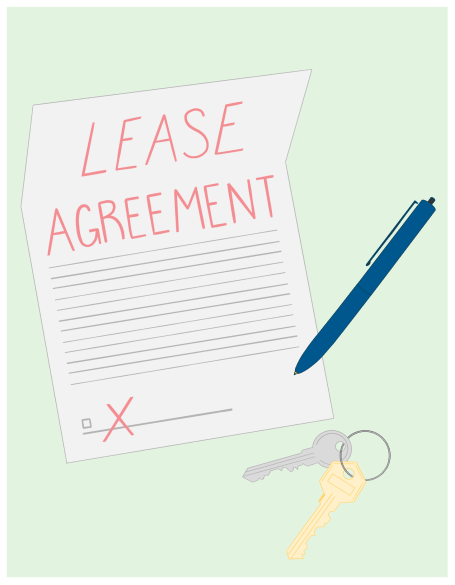
While it can all seem like legal jargon, the stuff found in your lease can greatly affect your everyday life; it’s not only the rent amount, but also rules on how to use the space, from noise complaints to subletting.
What’s really important is that you know your rights as a renter. All those Housing Counseling Centers previously mentioned can help you understand your rights as a tenant if you would prefer to speak to someone in real life. Otherwise, the government has a bunch of helpful sites for breaking down your rights, too — like this one.
If you have any questions about the lease or feel like anything is out of sorts, ask the apartment manager. And never sign anything you aren’t completely comfortable with.

RENTER’S INSURANCE
You signed the lease! So you can move in, right?
Yes — but there’s one more thing to think about. Many apartments require renters insurance, and it's a good thing to have regardless. It can also be an unexpected expense for many first-time renters. So what does renter’s insurance do, and how can you get it?

Usually there are three prongs of renter’s insurance: personal property insurance, liability coverage and additional living expenses.
Personal property insurance does exactly that — insures your personal property. Although the landlord has insurance on the building structure, your own personal items will not be covered. Therefore, if your stuff is stolen or damaged, that’s what your renter’s insurance is there to cover.
Liability coverage is in case someone else gets injured or breaks something and you can be held legally responsible. For example, if you’re playing your best game of Wii Sports, forget to put the wrist strap on and send the Wii remote flying through your neighbor’s window, liability coverage can help you cover the expenses. Same thing for any medical bills, if you happened to hit someone and not just a window.
Finally, additional living expense insurance is for if something really big happens — like a natural disaster — and your unit is uninhabitable. Your renters insurance can cover a place for you to stay while your apartment is being fixed.
You can read more on types of coverage plans and further on renters insurance here.
Renters insurance is not that expensive, so the benefits far outweigh any costs. Monthly payments are typically no more than $15, coming out to $180 a year.


YOU LOST
PLAY AGAIN?
Housing Hunt
Put your mouse on the mouse to start
The Rules:
- Start on the mouse icon
- The goal is to make it to your new home
- DO NOT TOUCH THE WALL or it will be game over
Congratulations!
PLAY AGAIN?
This Article was:
- Written by: Trinity Balboa
- Illustrated by: Cyan Carey
- Designed by: Riley Nguyen
- Developed by: Camron Hinkle
- Cloneable base from @kckatcreative

This Webflow Clonable was created by KC Kat Creative
For more of our work check out kckat.com
- All images pulled from the incredible twitter account, @CatWorkers aka Cats with Jobs
- Lil clock code used from this codepen: https://codepen.io/ed-fast/pen/ExjbRe