WRITTEN BY SAMANTHA HO
PHOTOGRAPHED BY JULIANA GARCIA AND NYLA LAWSON
PROGRAMMED BY GABRIELLE VIDAL
DESIGNED BY NAYA MORGAN
“It feels like the world’s full of distractions. And I look up, preferably to a clear sky, and it gives me a moment to breathe, to reevaluate, and to clear my head or just pause, thinking about and kind of take in the serenity,” says Andrew Dillingham, 26, of Logan Square.
In the hustle and bustle of the windy city, it’s easy for people to keep their head down and their gaze straight forward. Even side-to-side perhaps. However, unless there’s something catching their attention--the historic and ornate architecture, looming skyscrapers, frequent planes and helicopters, vindictive pigeons--some Chicagoans don’t bother to look up at the sky.
“It even varies on what’s happening in the sky. Whether it’s just a clear blue or it’s full of clouds or speckled with clouds, or even like a dark and stormy day when it feels like the sky is blanketed in this infinite gray sheet. Looking up makes me think about it, and I don’t think there’s much physically to be thought about besides what I can see. Any time I look at whatever feels like a blank canvas, it feels like an invitation to reflect,” Dillingham says.

What Dillingham is experiencing has a new field of research behind it: Skychology. It's a term coined by Paul Conway, a researcher and life coach, who explains it as "a new area of wellbeing research, defined as the study of the relationship between looking at the sky and wellbeing."
In 2019, Conway published a study with Kate Hefferon, a research psychologist at the University of East London.
Their findings state: “The sky plays an important role in the lives of the participants; it is a valued relationship and a frequent, intrinsically motivated, self-regulating experience, conferring beneficial outcomes.” It was a small study, however--just four participants--and has yet to be replicated. The authors acknowledge it needs to be repeated with a larger and more diverse sample size.

Lynette Lewis
Lynette Lewis, 22, a graduate student in Chicago, says she spends much of her time hunched over a screen, stressing about her workload. She is in a psychology program, and says her school emphasizes a healthy work/life balance. “But then they don’t really tell you how or give us time to do that,” she says. She’s still trying to figure out what self-care looks like for herself.
Looking up helps, however. Sometimes, she looks up toward the Chicago skyline and notices the lights left on in the building across from her and the people inside. “I’m wondering what those people are stressed about or what’s going on in their lives, and the stress of every day isn’t unique to me,” Lewis says.
Looking further up amplifies that feeling. “The sky reaffirms that, like we’re so small and there’s so many of us and we’re all kind of experiencing the same sense of confusion," she says. “We’re all so small, and every person has dealt with this before us. Everyone will deal with the same feeling after us. And so, in a good way, if nothing matters, then we get to choose the things that do matter."

Fred Previc
Fred Previc, an associate professor in psychology at the University of Texas San Antonio, is unsurprised by this response. “It is true that we generally accord more positivity with upper space than lower space,” he says, attributing upper with “upward mobility, upper-hand” and “uplifting,” whereas lower space can be matched with “downtrodden” or “sinking.”
Previc thinks the expansiveness of the sky encourages feelings of potential. “This can be more linked to things like motivation [or goals], which proceed into the distance,” he says.
According to Conway and Hefferon’s study, “Looking at the sky also imbues feelings of greater connectedness, towards others and the natural world, alongside a heightened sense of perspective and awe.”

Diya Guptaray
Diya Guptaray, 22, a graduate student in Chicago, says she is always under pressure. “There is always so much to do," she says. "I feel like no matter how much I get done, there is still so much more to do.”
When looking at the sky, she said she feels like she is “able to take deep breaths and let the stress out.” She also feels a sense of connection. “I find comfort in that me and all my friends and family are under the same sky even if they are halfway across the world," she says. "I know we’re connected somehow through the sky.”

Neel Patel
Neel Patel, 23, who works for an audio visual company in Chicago, was headed home from work when he took a few minutes to look up. His attention was drawn by the overcast and pockets of dim sunlight, which he says helps him ease his mind from any of his responsibilities at work.
“It’s scattered clouds and a little bit of light before the night comes down,” Patel says. “It’s more of a transitionary period, that being the transition between more of an exciting time to more of a calmer time.
”For Patel, that connects to his life. “It’s just me, myself and I and the entire environment,” he says. “I reflect a little bit more about my personal life, that being just stuff that affects me instead of anybody else.”

The skychology study called out the metaphor that clouds provide. When people look up, the authors wrote, “Challenges are re-evaluated with renewed clarity, their significance ameliorated through an existential realization of their place in the universe; knowing that they too, shall pass, like clouds, across the infinite, impermanent sky.”

It's almost impossible not to notice the clouds when looking up. After all, these cottony entities are some of the most frequent visitors of the sky.
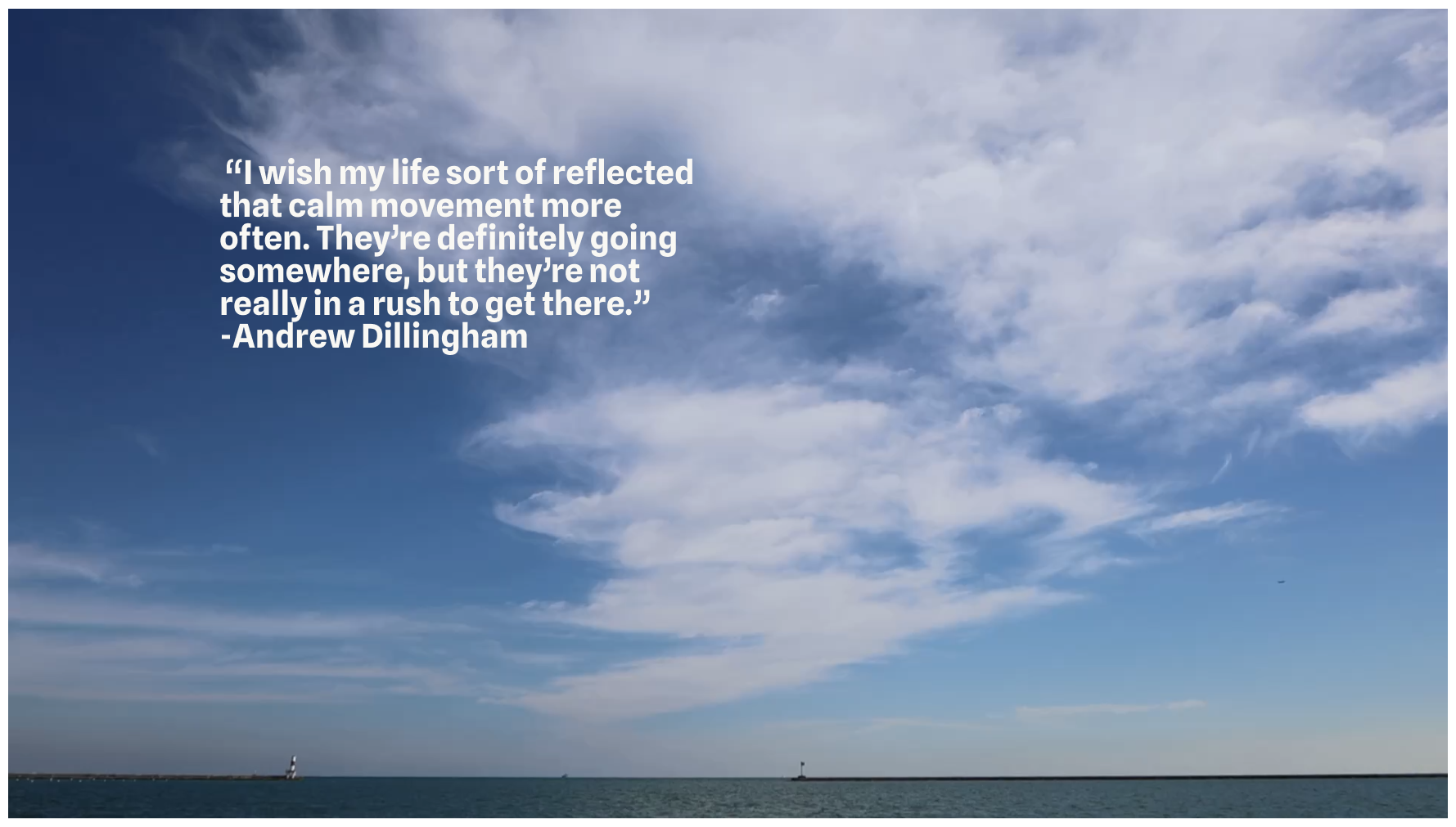
Dillingham says he likes to pay attention to the slow movement of the clouds. "They’re like continents; they move very slowly and very placidly across the sky, which I find fascinating,” he says. “I wish my life sort of reflected that calm movement more often. They’re definitely going somewhere, but they’re not really in a rush to get there.”