
Chicago is often known by it’s nickname: The Second City.
A possible root for the nickname is the popularity of Chicago in comparison to New York. But it may also trace its origins to the Great Chicago Fire of 1871, which destroyed nearly a third of the city. Chicago rebuilt a second city on top of what had burned. While the origin of the nickname remains a contentious topic, it’s certainly true that Chicago has a culture of change and reinvention.
For generations, the skyline has sat as a layered welcome mat to those entering the city for the very first time. A forever-changing gallery brimming with architecture new and old.
“If you go to downtown Manhattan, and you try to look at all the tall buildings in the financial district, it's very hard to get a view of any one particular building. It's all kind of just like the mass of the concrete canyon,” says Adam Rubin, senior director of public engagement at the Chicago Architecture Center.

Rubin, who moved to Chicago from Los Angeles seven years ago, found Chicago’s architectural landscape to be completely different than anything he had seen before. But it continues to change, and the tug between development and preservation continues to change the skyline.
This process happens in one of three ways. A building will enter the space for preservation and either gain the recognition it needs to remain standing, or receive necessary changes to keep it useful for the community.
If the building is not renovated or awarded historical status, then the building can fall into disrepair and sit vacant. If the building is located on prime real estate, especially nearby a university or hospital, it is likely to be slated for demolition.

Built in 1925, the theater has undergone numerous changes. It started out as one of Chicago’s iconic movie palaces for black-and-white silent films, with a Spanish Baroque Revival facade and a grand, six-story lobby. Over the years, it hosted vaudeville acts and musicals before becoming a movie palace once more for color and sound films. In the 1970s, the theater became a live music venue. Artists including Bruce Springsteen, Prince, the Grateful Dead and Frank Zappa all performed there.
Damage caused by burst water pipes caused the Uptown Theatre to close in 1981. It’s been sitting in the public consciousness since then, abandoned, deteriorating and waiting for another revival. During that time, it was added to the National Register of Historic Places and named a City of Chicago Landmark. Several times, renovation was scheduled but never started. The future of the theater remains up in the air.
Rubins argues that saving a building is not only good for sentimental reasons, but also for the environment. Demolishing an existing building and rebuilding on top of it releases massive amounts of carbon.
But there's also a lack of space for new buildings unless old ones are demolished. “We're at a point in urban life where cities are built out," Rubins says. "It's much more of a rarefied thing to say there's wide open space for designing new things. Which means for over the past 100 years, give or take, we've been building things.”

For Rubins, that's another strong argument for preservation. "There is an environmental imperative to work with what you have to make sure that it functions for new uses or new people.”
Preservation can also save structures that would be impossible to build today. Elaborate stone and brickwork are not feasible for new buildings because they require too much time and money.
“The brickwork, the craftsmanship, the limestone. We just don't do that as a society anymore, not just here, but any place hardly in the world," says Lee Bey, an architecture critic and author of the book Southern Exposure: The Overlooked Architecture of Chicago's South Side. "To be able to save that is fantastic. They're popular, but the craftsmanship to put together is really expensive as opposed to back in the old days.”
Bey says preservation sometimes requires creative solutions. This means a building might not be saved as-is; it might be repurposed for a new use.
“The schools that Mayor Rahm Emanuel closed, the 15 public schools, you're slowly beginning to see them come back to life again as residential buildings. And that's good," he says.
Not all historical buildings have ornate facades and old-world craftsmanship, however. Chicago is also home to some historical concrete giants.
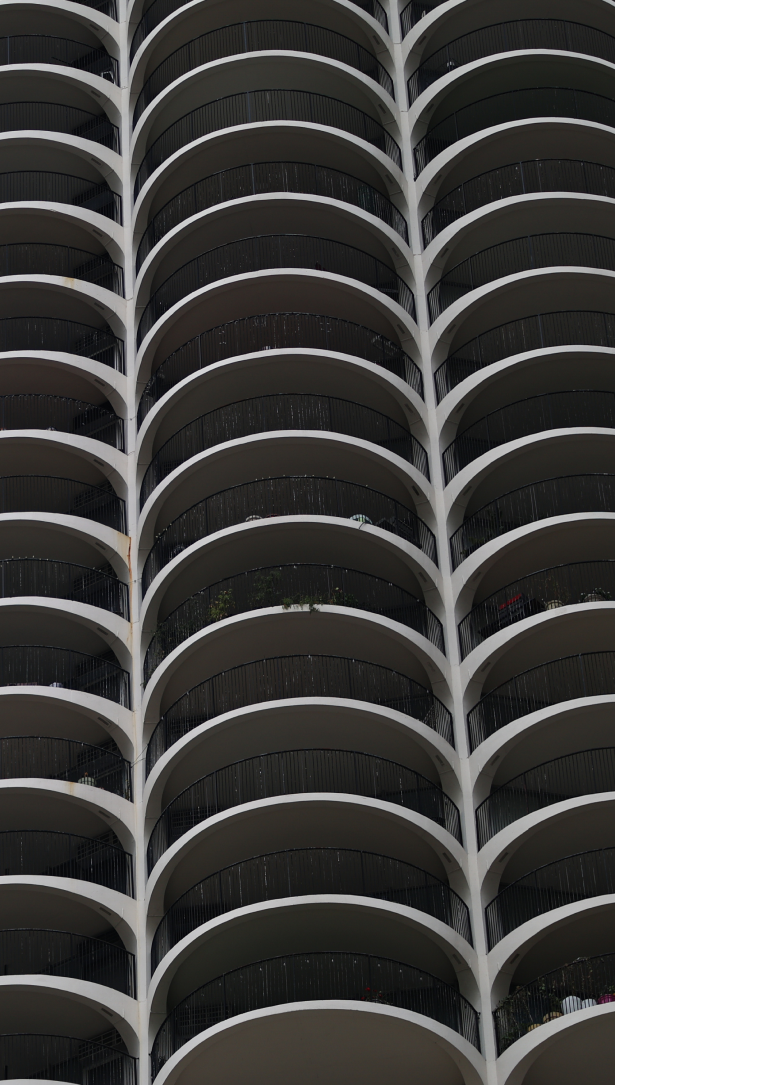
Marina City -- sometimes called the "corn cobs"-- was designed by architect Bertrand Goldberg and built in the early 1960s. It consists of two towers along the Chicago River and was designed to be a “city within a city” with parking, offices, a theater, a marina, and even an ice skating rink and a bowling alley.
The buildings themselves are circular with a rough concrete design. They have preserved and updated over the years to accommodate modern apartments that remain popular due to their proximity to the Chicago Riverwalk and downtown amenities.
Goldberg also designed Prentice Women’s Hospital and Maternity Center in the 1970s. The hospital shared many architectural characteristics with Marina City, including its concrete design. After it was abandoned in 2011, Northwestern University planned to demolish it. Multiple attempts were made to save Prentice Hospital from demolition after the Chicago Landmarks Commission voted against giving the hospital landmark designation. Despite a campaign by the National Trust for Historic Preservation, it was demolished in 2014.
Preservationist Vincent Michael fought to save Prentice Hospital in 2012. He describes Bertrand Goldberg’s work as “second generation organic.” While many would use the term “brutalist” to describe the concrete structures, Michael argues that there are organic and expressionistic elements to Goldberg’s designs that are often overlooked. Just as Marina City closely resembles corn cobs, Prentice Women's Hospital sat on its concrete stem like a flower.
“We rarely got preservation to that high a profile. We did press conferences there. We tried to convince them of the significance of the building,” Michael says. “It had some fascinating design elements, essentially it's a panopticon plan.”

Not all historical buildings have ornate facades and old-world craftsmanship, however. Chicago is also home to some historical concrete giants.
Like Marina Towers, Prentice had a raw concrete exterior, but it also had cantilevered oval windows over a rectangular base. Goldberg borrowed early computers from the Navy to create the outline of the hospital decades before computer programs became commonplace for architectural design.
But efforts to preserve it failed. “It was sort of unfortunate to watch," Rubins says. "Prentice Tower came down right at the moment that if we had waited a few years longer people would have understood it in a different way." He says there's a 50-year threshold after which people begin to appreciate architecture from the past. Prentice didn't last long enough to be appreciated.
While Chicago has lost many important buildings over the years, many still live on. Passionate Chicagoans continue to fight for the city's historical buildings. From the Rookery Building to the Pullman Houses, to what has been lovingly dubbed “goth Target” on State Street, Chicago’s architectural gems live on.
“Preserving the buildings, it's part of the soul of the city," Bey says. "And we're better at it than we used to be. Still not perfect. Still not as good as we should be. But I think with advocates, news coverage and other things, we can slowly make it better."
